
Speedy, Alma, Keepall, Noé: which vintage Louis Vuitton bag should you choose?
Louis Vuitton's great classics have changed very little over the decades. A 1990s Speedy has almost the same silhouette as a recent one, and many vintage pieces were made in France. The question is which one suits your everyday life. Here are the five models you will come across most often in vintage, and what to look at on each.
The five models at a glance
| Model | History | Shape | Worn | Best for |
|---|---|---|---|---|
| Speedy 30 | 1930s | Soft, zip closure | Hand or crook of the arm | Everyday city use |
| Alma PM | 1934, named Alma in 1992 | Structured, dome-shaped | Hand | A dressier look |
| Keepall 55 | 1930 | Soft, very roomy | Hand, or shoulder in the Bandoulière version | Travel and weekends |
| Noé / Petit Noé | 1932 | Bucket with a drawstring | Shoulder | A practical, relaxed bag |
| Luco | Now discontinued | Flat tote with a zip | Shoulder | Work and documents |
The Speedy: the everyday icon
Born in the 1930s as a smaller version of the Keepall, the Speedy became the House's most emblematic city bag. It comes in several sizes, from 25 to 40; the Speedy 30 (30 × 21 × 17 cm) remains the most versatile: big enough for a wallet, keys, a phone and a small notebook, without being bulky. It closes with a zip, with a tab designed for a padlock.
Vintage Speedys have no shoulder strap: they are carried by hand or in the crook of the arm. As the bag is soft, look at how it holds its shape, at the condition of the natural leather handles and at the corners of the base, which rub on the ground.
In our selection: a 1987 Speedy 30 sold with its padlock, a 1995 Speedy 30 and a 2000 Speedy 30 with a very deep patina.
The Alma: the Art Deco line
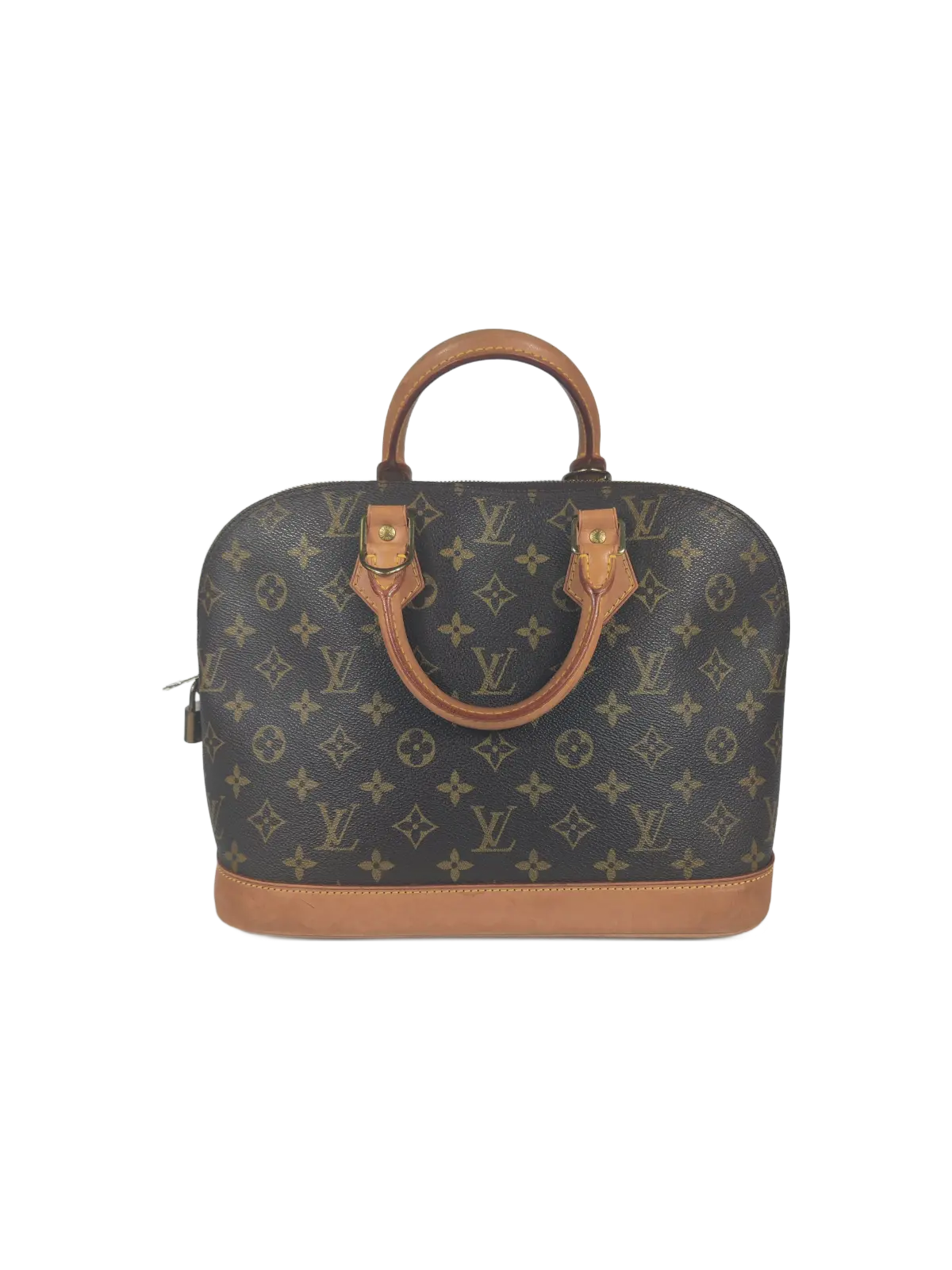
The Alma descends from a bag created in 1934, the Squire. It took the name Alma in 1992, after Place de l'Alma in Paris. Its well-structured dome shape gives it a dressier look than the Speedy, and it stands up on its own. The PM size (32 × 24 × 16 cm) is the most common.
On a vintage Alma, shape comes first: an Alma that sags has lost some of its charm. Also check the corners of the base and the piping, the thin edging that outlines the silhouette and wears over time.
In our selection: a 1999 Alma PM and a 2000 Alma PM with a lovely honey patina.
The Keepall: the travel bag
Created in 1930, the Keepall is a soft travel bag designed to be folded and stored away when not in use. It comes in 45, 50, 55 and 60 cm, among others. The 55 is a good size for a weekend; it is often used as cabin luggage, but accepted dimensions vary between airlines. The Bandoulière version adds two rings for a shoulder strap.
On a Keepall, look at the zip, the handles, the base, which carries the weight of the contents, and the corners. Also check which accessories are included: the strap, name tag and padlock are often sold separately or missing on an older bag, and the price should reflect that.
In our selection: a 1996 Keepall Bandoulière 55, sold without its shoulder strap.
The Noé: the champagne bucket turned handbag
The Noé was designed in 1932 to carry bottles of champagne, hence its bucket shape and drawstring closure. The Petit Noé is a more compact version, very practical for everyday use. It comes in Monogram canvas, but also in Épi leather, the textured leather the House launched in 1985.
Unlike the natural leather on the canvas models, Épi leather does not take on a honey patina: look instead at colour wear on the corners and edges, the condition of the drawstring and that of the lining.
In our selection: a 1994 Petit Noé in Toledo Blue Épi leather.
The Luco: the work tote
Less well known than the others and now discontinued, the Luco is a flat Monogram canvas tote with a zip, worn on the shoulder. It easily takes documents, a tablet or a small laptop depending on the size, which makes it a good work bag.
In our selection: a 2000 Luco, made in France.
Beyond the model, look at the condition
On a vintage Louis Vuitton bag, condition often matters more than the model itself. A few things to check:
- The natural leather patina: handles and tabs in natural cowhide leather darken over time and take on a honey tone. This is normal and sought after, as long as the patina is even and the leather has no deep cracks.
- The Monogram canvas: it is very durable, but can crack at the corners and folds on a heavily used bag.
- The interior: on bags from this era, the coating of some inside pockets can become sticky. It is not a deal-breaker, but it should be disclosed.
- The date code: it tells you where and when the bag was made, and lets you check that it is consistent with the model. Our guide explains how to read a Louis Vuitton date code.
Every bag in our selection is authenticated, then graded according to our condition scale, from grade S to grade C, with photos of every flaw.
Find your vintage Louis Vuitton
See all our models in the Louis Vuitton collection. Looking for a particular size, year or canvas, such as Damier or Épi in a specific colour? Our personal shopping service will find it for you.

Leave a comment
This site is protected by hCaptcha and the hCaptcha Privacy Policy and Terms of Service apply.